> ## Documentation Index
> Fetch the complete documentation index at: https://docs.open-hive.com/llms.txt
> Use this file to discover all available pages before exploring further.
# Credentials
> Connect the accounts, tools, and models your agents work with.
**Configuration → Credentials** is where you give agents access to the outside world.
It has two halves: **Built-in Connections** for accounts OpenHive integrates with
directly, and **API Keys** for the long tail of everything else.
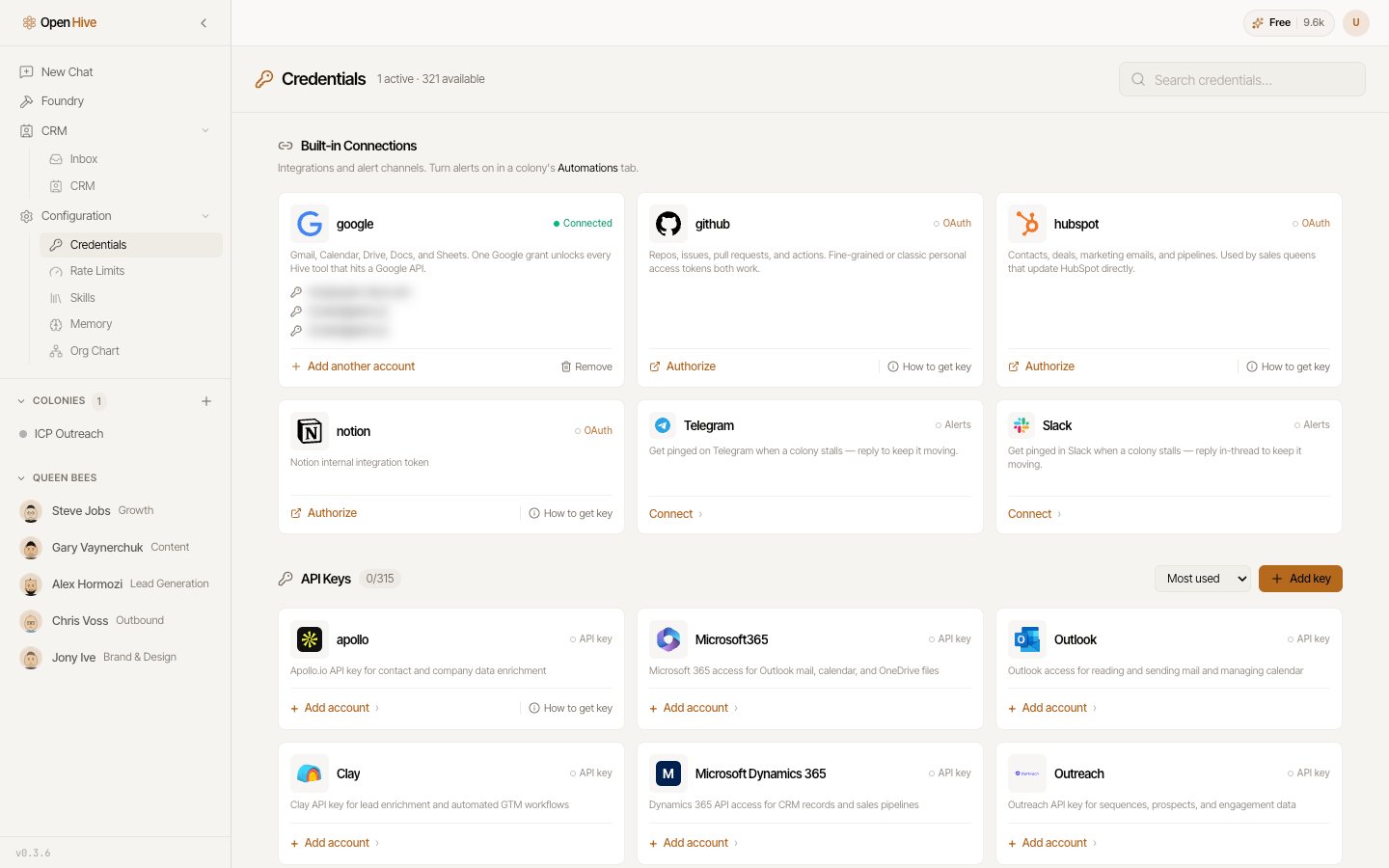 Search across both from the top of the page.
## Built-in Connections
These are first-class integrations, authorized over OAuth rather than by pasting a key.
| Connection | Unlocks |
| ----------- | ------------------------------------------------------------------------------------------------------------- |
| **Google** | Gmail, Calendar, Drive, Docs, and Sheets. One Google grant covers every OpenHive tool that hits a Google API. |
| **GitHub** | Repos, issues, pull requests, and actions. Fine-grained and classic personal access tokens both work. |
| **HubSpot** | Contacts, deals, marketing emails, and pipelines. Used by sales queens that update HubSpot directly. |
| **Notion** | Connects through an internal integration token. |
A connection can hold **multiple accounts** — use **Add another account** when you need
separate identities for separate workspaces or clients.
### Alert channels
**Telegram** and **Slack** are connected here too, but they carry alerts rather than
data. Connect one and you get pinged when a colony stalls — and you can reply in the
chat to keep it moving, without opening the app.
Alert channels are enabled per colony, in that colony's **Automations** tab, not
globally. Connecting the channel here only makes it available.
## API Keys
Everything else is an API key. The catalog is large — several hundred entries covering
CRMs, enrichment and data providers, warehouses, databases, and email delivery. Each
entry lists exactly the fields it needs, from a single key to a full connection (host,
port, database, user, password).
Sort by **Most used** to surface the common ones, or search if you know what you want.
Several entries link to **How to get key**, which saves hunting through a provider's
docs.
The catalog is broader than what OpenHive can currently complete a connection for.
Entries that aren't wired up yet show **Connect** disabled, so you can see what's
coming without starting a flow that can't finish.
## Model providers
Your model keys live in the same API Keys section. By default agents run on OpenHive's
routed model pool, drawing on your bundled allotment; adding your own provider key
bypasses that allotment and bills you directly with the provider.
| Provider | Notes |
| -------------- | ------------------------------------------------------------------------------------- |
| **Anthropic** | Claude Opus, Sonnet, and Haiku. |
| **DeepSeek** | V3 and R1 reasoning models. Cheap throughput for bulk tool-using turns. |
| **Groq** | LPU-backed inference for sub-second responses — Llama and Mixtral at high throughput. |
| **Moonshot** | Kimi K2 with 1M+ token context. Good for long-document and multi-file agents. |
| **OpenRouter** | Open-source model proxy — Llama, Qwen, DeepSeek, Mixtral and more behind one key. |
| **OpenHive** | The routed pool. Used as the fallback when no other provider key is configured. |
For high-volume work — bulk enrichment, large prospect lists — a DeepSeek or Groq key
is usually the cheapest way to scale it. See
[Credits and plans](/account/credits).
Credentials are held for use by the runtime on your machine. Treat the machine running
OpenHive as you would any machine holding production API keys.
Search across both from the top of the page.
## Built-in Connections
These are first-class integrations, authorized over OAuth rather than by pasting a key.
| Connection | Unlocks |
| ----------- | ------------------------------------------------------------------------------------------------------------- |
| **Google** | Gmail, Calendar, Drive, Docs, and Sheets. One Google grant covers every OpenHive tool that hits a Google API. |
| **GitHub** | Repos, issues, pull requests, and actions. Fine-grained and classic personal access tokens both work. |
| **HubSpot** | Contacts, deals, marketing emails, and pipelines. Used by sales queens that update HubSpot directly. |
| **Notion** | Connects through an internal integration token. |
A connection can hold **multiple accounts** — use **Add another account** when you need
separate identities for separate workspaces or clients.
### Alert channels
**Telegram** and **Slack** are connected here too, but they carry alerts rather than
data. Connect one and you get pinged when a colony stalls — and you can reply in the
chat to keep it moving, without opening the app.
Alert channels are enabled per colony, in that colony's **Automations** tab, not
globally. Connecting the channel here only makes it available.
## API Keys
Everything else is an API key. The catalog is large — several hundred entries covering
CRMs, enrichment and data providers, warehouses, databases, and email delivery. Each
entry lists exactly the fields it needs, from a single key to a full connection (host,
port, database, user, password).
Sort by **Most used** to surface the common ones, or search if you know what you want.
Several entries link to **How to get key**, which saves hunting through a provider's
docs.
The catalog is broader than what OpenHive can currently complete a connection for.
Entries that aren't wired up yet show **Connect** disabled, so you can see what's
coming without starting a flow that can't finish.
## Model providers
Your model keys live in the same API Keys section. By default agents run on OpenHive's
routed model pool, drawing on your bundled allotment; adding your own provider key
bypasses that allotment and bills you directly with the provider.
| Provider | Notes |
| -------------- | ------------------------------------------------------------------------------------- |
| **Anthropic** | Claude Opus, Sonnet, and Haiku. |
| **DeepSeek** | V3 and R1 reasoning models. Cheap throughput for bulk tool-using turns. |
| **Groq** | LPU-backed inference for sub-second responses — Llama and Mixtral at high throughput. |
| **Moonshot** | Kimi K2 with 1M+ token context. Good for long-document and multi-file agents. |
| **OpenRouter** | Open-source model proxy — Llama, Qwen, DeepSeek, Mixtral and more behind one key. |
| **OpenHive** | The routed pool. Used as the fallback when no other provider key is configured. |
For high-volume work — bulk enrichment, large prospect lists — a DeepSeek or Groq key
is usually the cheapest way to scale it. See
[Credits and plans](/account/credits).
Credentials are held for use by the runtime on your machine. Treat the machine running
OpenHive as you would any machine holding production API keys.